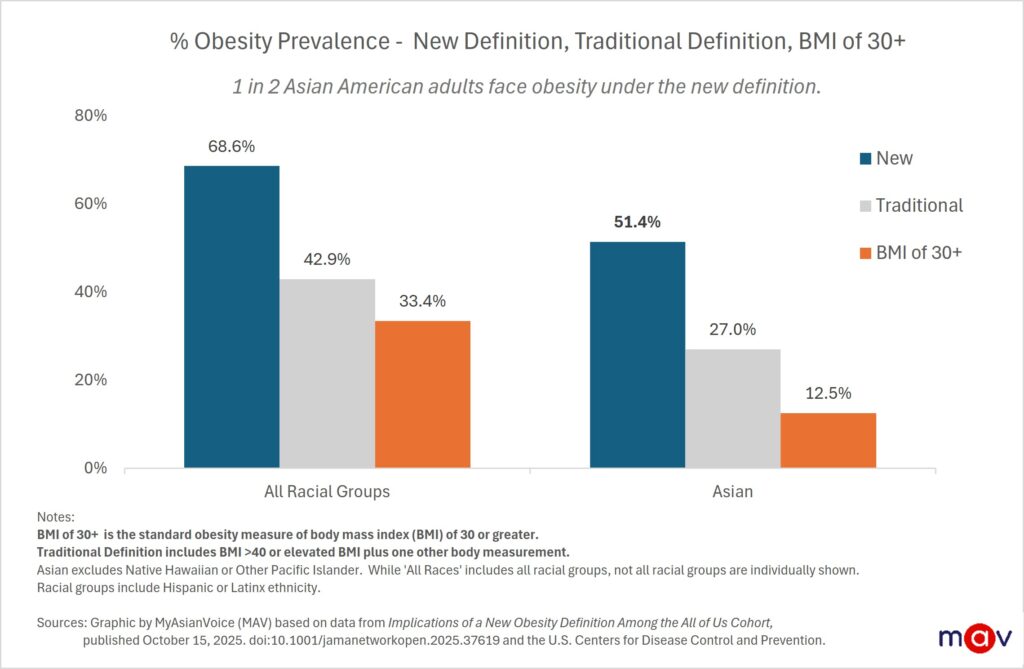
Many Asian Americans may be obese without realizing it. Under a new obesity framework proposed by researchers, obesity rates have risen across all racial groups—particularly among Asian Americans. 51.4% of Asian Americans adults were found to be obese under the new definition, a staggering increase from 12.5% under the standard measure of BMI of 30 or greater. The updated definition considers body composition, meaning that even people who appear to have a healthy weight can be classified as obese if certain body measurements meet the new criteria. The study also found that obesity prevalence under the new definition varied by sex, race, and age.

It’s a new year, and many Asian Americans may find themselves as obese under a new obesity framework proposed by researchers. Under this new definition, obesity rates have risen across all racial groups—particularly among Asian Americans. The updated framework accounts for body composition, meaning that even people who appear to have a healthy weight can be classified as obese if certain body measurements meet the new criteria.
Nearly 70% of American adults are obese under a new proposed definition of obesity.
According to a comprehensive study that analyzed health data from more than 300,000 adults in the All of Us research program, the obesity rate jumped to 68.6% under the new definition—up from 42.9% under the traditional definition that uses body mass index (BMI), which estimates body fat using a person’s weight and height. This dramatic rise was entirely driven by adults with what researchers call anthropometric obesity—those who have at least two elevated body measurements regardless of BMI level. In other words, someone could have a “normal” BMI yet still qualify as obese if they have two or more elevated body indicators, such as waist circumference, waist-to-hip ratio, waist-to-height ratio. The study also found that obesity prevalence under the new definition varied by sex, race, and age.
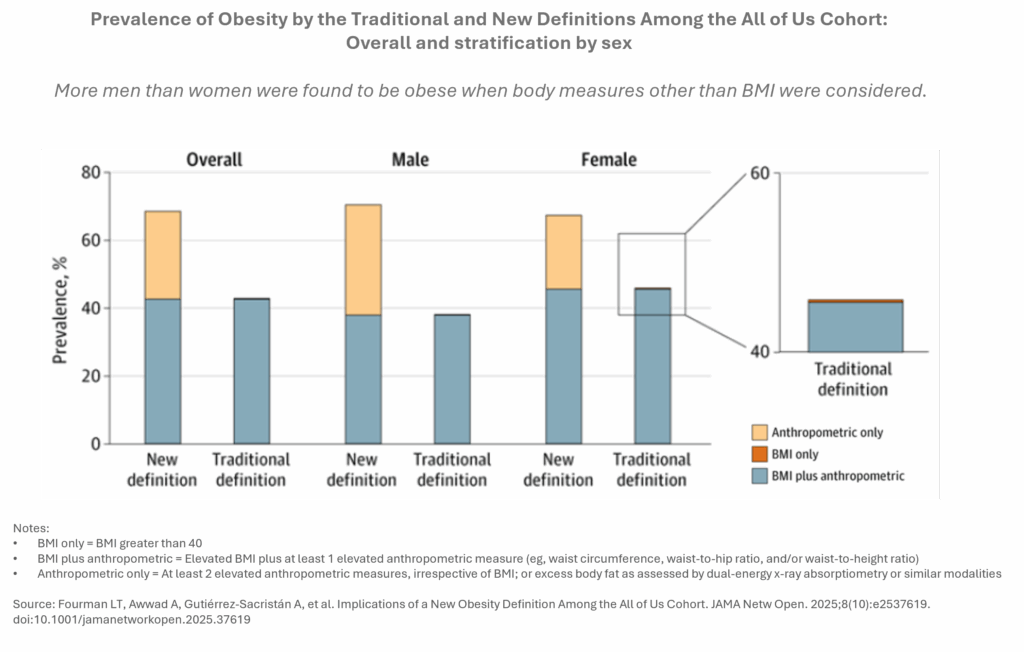
Obesity by gender
Overall obesity prevalence was similar between men and women under the new definition, though more men than women had anthropometric obesity.
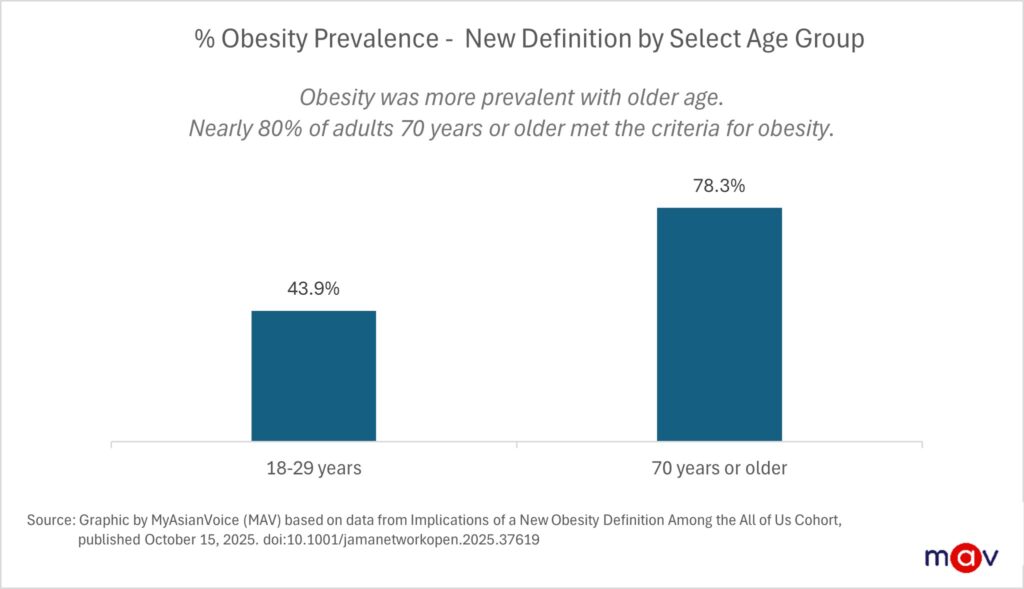
Nearly 80% of adults aged 70 or older are obese
Age played a major role in obesity prevalence. Astonishingly, 78.3% of adults aged 70 or older met the criteria for obesity under the new definition. This finding aligns with earlier research showing that fat tends to accumulate centrally—especially around the abdomen—as people age.
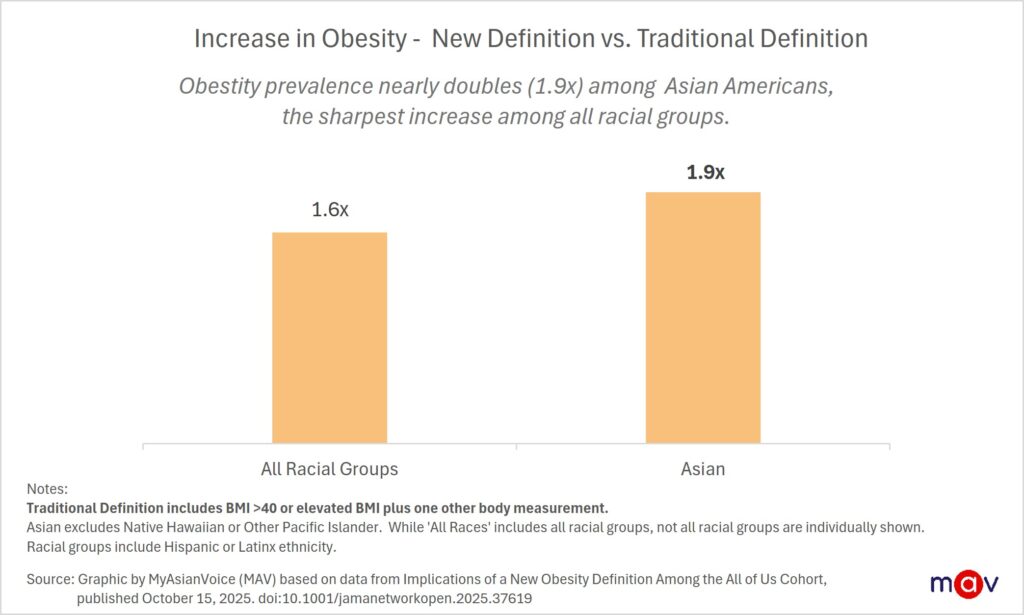
Largest increase among Asians
Among racial groups, the largest increase was seen among Asians. While the BMI-based definition, often shows lower obesity rates in Asian Americans, Asian Americans are also known to face heightened risks of diabetes and heart disease at a lower BMI. The research also found that metabolic dysfunction—problems in how the body converts food into energy—was particularly predominant among Asians.
Under the new definition, 51.4% of Asian Americans were found to be obese, a 90% increase from the traditional definition. The traditional definition used by researchers in the study included BMI only obesity (BMI > 40), and BMI plus anthropometric obesity (defined as an elevated BMI plus one other body measurement). The traditional definition produced higher obesity rates than the standard obesity definition of BMI of 30 or greater. For reference, the CDC reported a 12.5% obesity rate in 2024 among Asian Americans using a BMI of 30 or greater, a figure much lower than the 27.0% rate under the researchers’ traditional definition.
For millions of Americans, the top New Year’s resolutions for 2026 focus on getting healthier. Nearly half plan to exercise more (48%) and eat better (46%). These new obesity findings may motivate more Americans—and particularly Asian Americans—to take action, whether that means improving fitness or getting screened. After all, what defines obesity isn’t just numbers on the scale—body composition matters too.
***
This article contains original analysis and content developed by MyAsianVoice based on primary data published by third parties. While the underlying data may be publicly available, all insights, visualizations, and derived content, unless otherwise noted, are the intellectual property of MyAsianVoice and are protected under international copyright and intellectual property laws. If you use, reference, or cite any part of our analyzed data or content, you must provide full proper attribution. Required citation include: MyAsianVoice’s full name, title of the article, and direct link to the article.
Helpful Resources
Implications of a New Obesity Definition Among the All of Us Cohort (JAMA Network OPEN)
Overweight for Asian Americans begin at a BMI of 23 vs. 25 for most Americans (MyAsianVoice)
Is Obesity Different in Asian Americans? Expert Q&A (WebMD)
Obesity among Asian American people in the United States: A review (National Library of Medicine)
Get a monthly dose of our latest insights!




About
myasianvoice

At MyAsianVoice, we make disaggregated U.S. Asian data visible and accessible.
Subscribe to receive our latest insights >>