Government, Resources, Voices
What Asian Americans think about capitalism and socialism
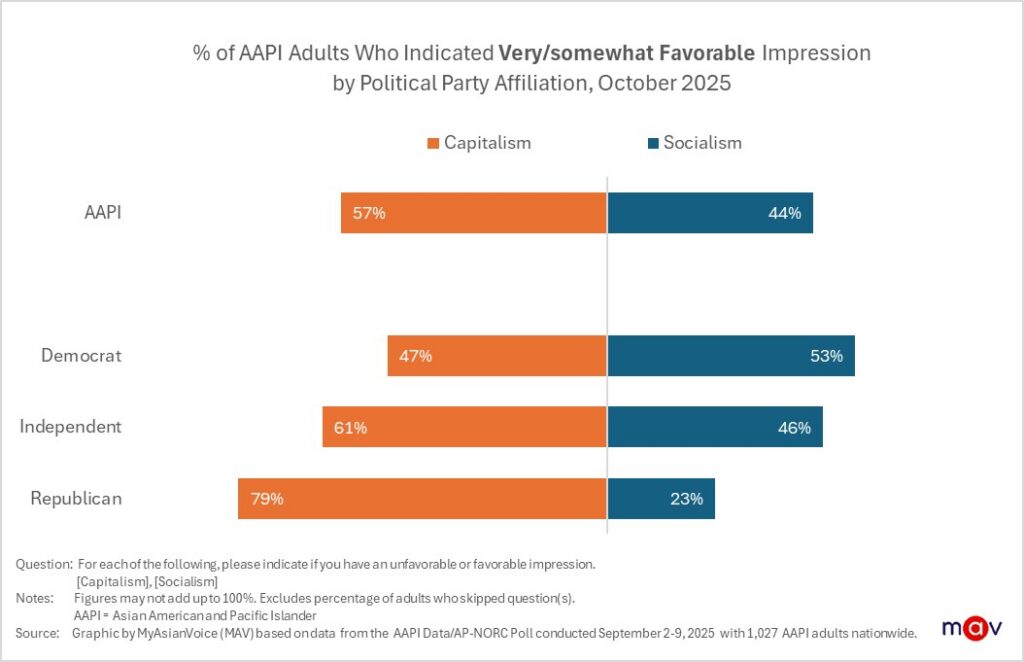
Asian Americans hold nuanced views on capitalism and socialism. According to a recent survey conducted by AAPI Data/AP-NORC, 57% of Asian American and Pacific Islanders have favorable views of capitalism, while 44% view socialism positively. Many respondents also say they don’t know enough to form an opinion of either economic system. These attitudes vary across Asian subgroups and are influenced by age and political affiliation.

Asian Americans hold nuanced views on capitalism and socialism. Broadly speaking, capitalism and socialism are economic systems that differ in how resources are owned, managed, and distributed. Capitalism is characterized by private ownership of the means of production and a profit-driven, free-market approach to distributing goods. Whereas, socialism involves government or social ownership of the means of production, aiming to reduce inequality and distribute resources based on community needs.
Favorability of capitalism and socialism
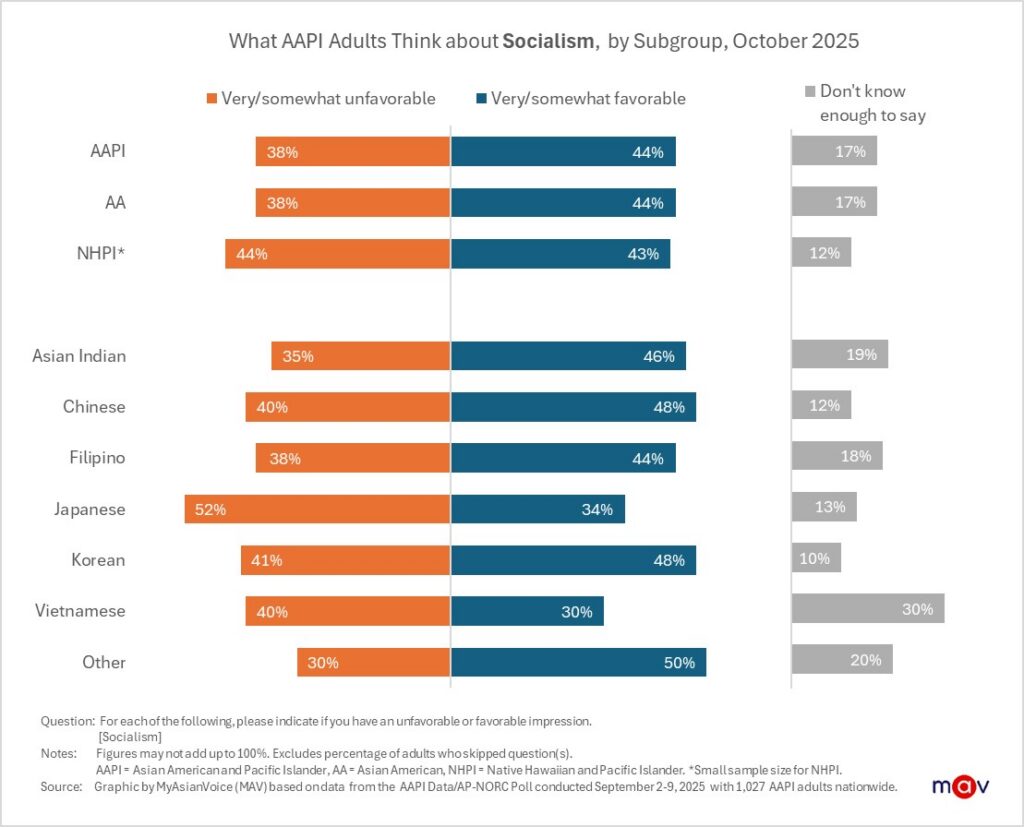
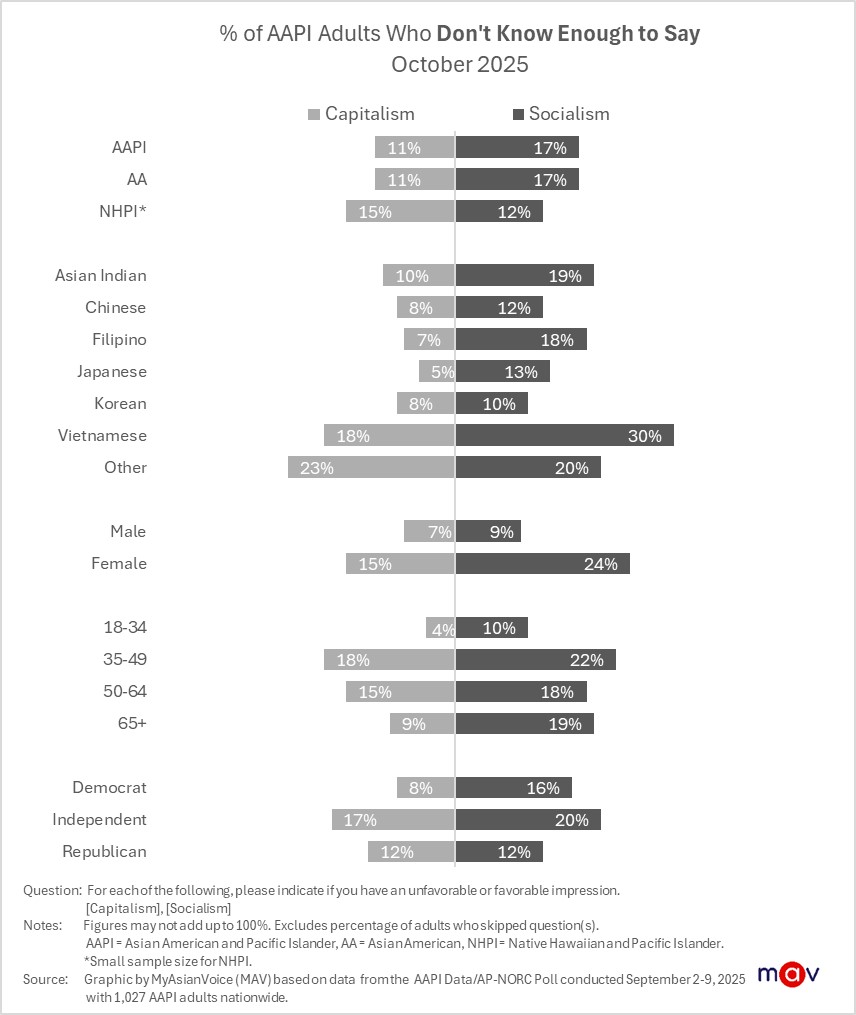
While capitalism remains popular, its appeal has declined in recent years. Gallup, which has tracked Americans’ views on economic systems since 2010, found that positive perceptions of capitalism fell to 54% in 2025, down from 60% in 2021. Similarly, the AAPI Data/AP-NORC survey found that 57% of Asian American and Pacific Islander (AAPI) adults view capitalism favorably and 44% have positive views of socialism. 11% and 17% of AAPI adults also say they don’t know enough about capitalism and socialism, respectively, to form an opinion.
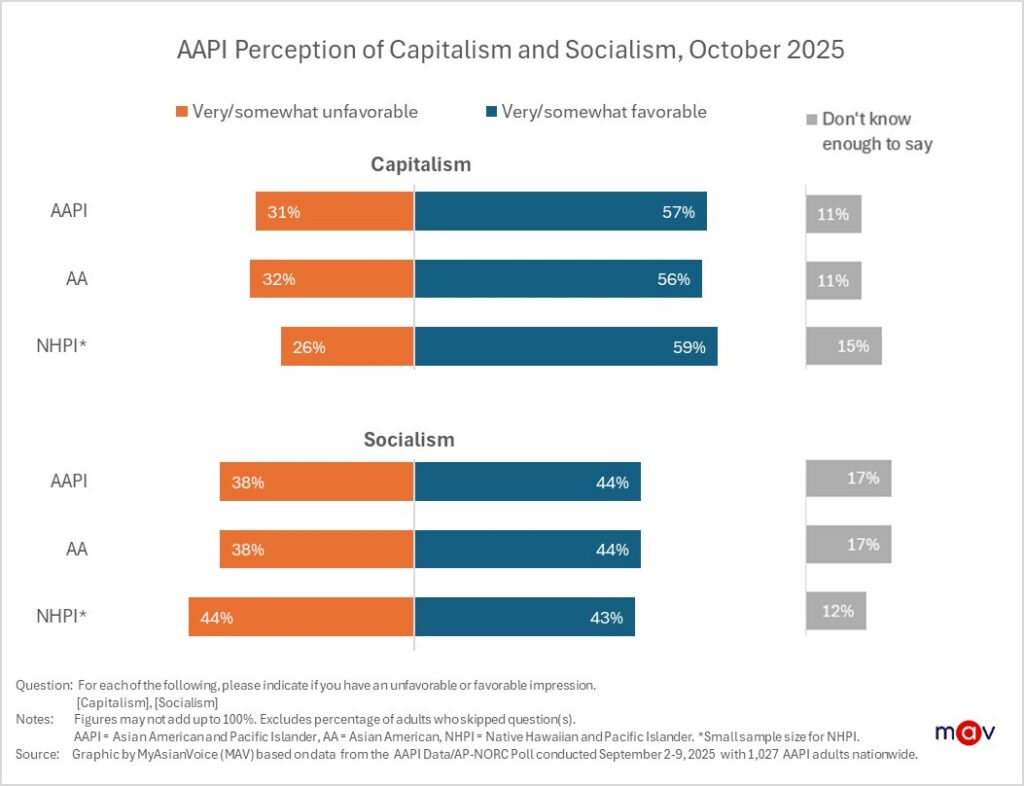
Although more Asian Americans favor capitalism, many also lean toward left-leaning political ideologies. 51% of AAPI adults view the Progressive movement positively, while only 26% have favorable views of the Make America Great Again (MAGA) movement. According to the U.S. government, the Progressive movement was an early 20th-century effort focused on social and political reform, curbing corruption by political machines and limiting corporate influence. Meanwhile, the MAGA movement, associated with President Donald Trump and right-wing policies, has often been linked to crony capitalism—where close ties exist between government officials and business leaders that influence economic outcomes.
Not surprisingly, even though a majority of AAPI adults have favorable views of capitalism, most hold unfavorable impressions of the MAGA movement. However, partisan divisions exist. Among AAPI Republicans, 70% express positive views of MAGA, while 63% of AAPI Democrats hold favorable views of the Progressive movement. Age also plays a role. Younger AAPI adults hold more favorable views of the Progressive movement, particularly those aged 18–34 who lean strongly progressive at 69% favorability. AAPI seniors aged 65 or older are divided, with 41% having favorable views of the Progressive movement and 39% for MAGA.
Age divide
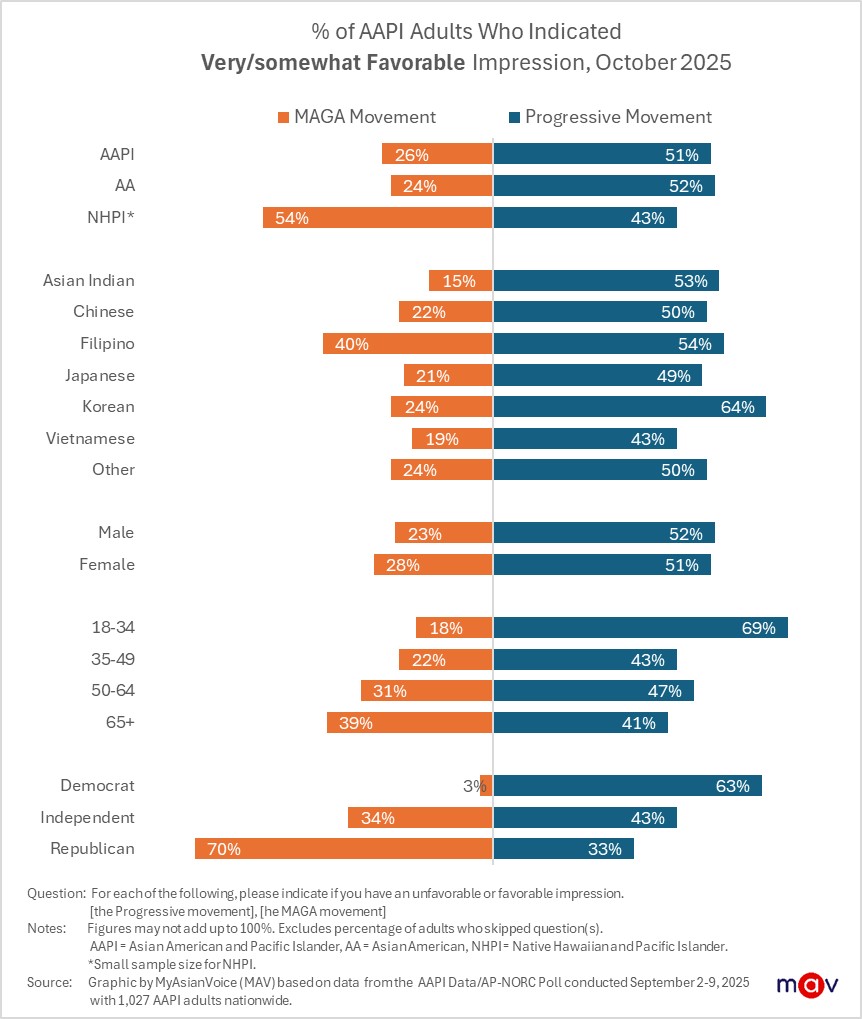
Economic attitudes also vary by generation. Older AAPI adults show higher favorability for capitalism, whereas younger AAPI adults are more open to socialism. Among AAPI adults aged 18–34, 64% view socialism positively, compared to 77% of seniors aged 65 or older who favor capitalism.
Party differences
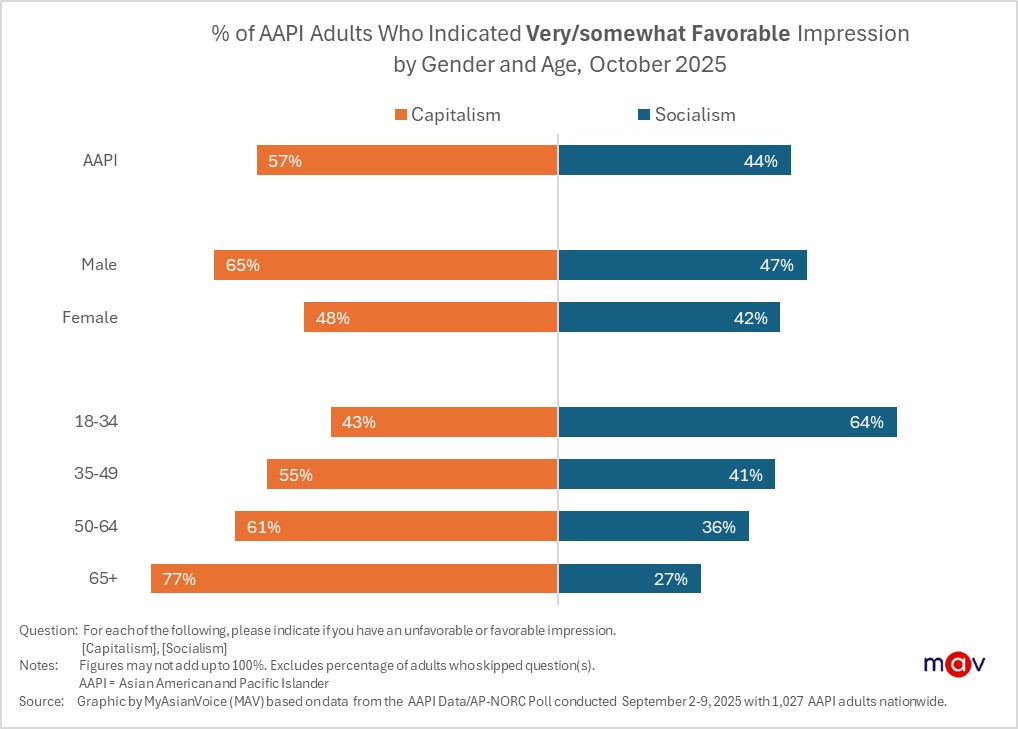
Party affiliation further influences these opinions. Among AAPI Republicans, 79% express favorable views of capitalism, while only 23% view socialism favorably. In contrast, AAPI Democrats and Independents hold more balanced perspectives—both groups report favorable impressions of capitalism and socialism. However, AAPI Democrats are slightly more favorable toward socialism at 53% than capitalism at 47%.
Asian subgroup
Favorability toward capitalism and socialism also varies by Asian subgroup. Filipino Americans (65%) and Chinese Americans (63%) are most likely to express positive views of capitalism. Meanwhile, Chinese (46%), Indian (46%), and Korean (48%) Americans show above-average favorability toward socialism compared to the overall AAPI average of 44%. Vietnamese Americans report lower favorability toward both systems, 47% for capitalism and 30% for socialism. A notable share of Vietnamese adults also say they don’t know enough to assess either system, 18% for capitalism and 30% for socialism.
Many are unfamiliar with socialism
The AAPI Data/AP-NORC survey also found that many Asian Americans and Pacific Islanders tend to support socialist-aligned policies—such as government-funded healthcare or education—more than the term socialism itself. 17% of AAPI adults say they don’t know enough to express an opinion about socialism. This uncertainty is higher among AAPI women at 24%, Vietnamese Americans at 30%, Independents at 20%, and AAPI adults aged 35–49 at 22%.
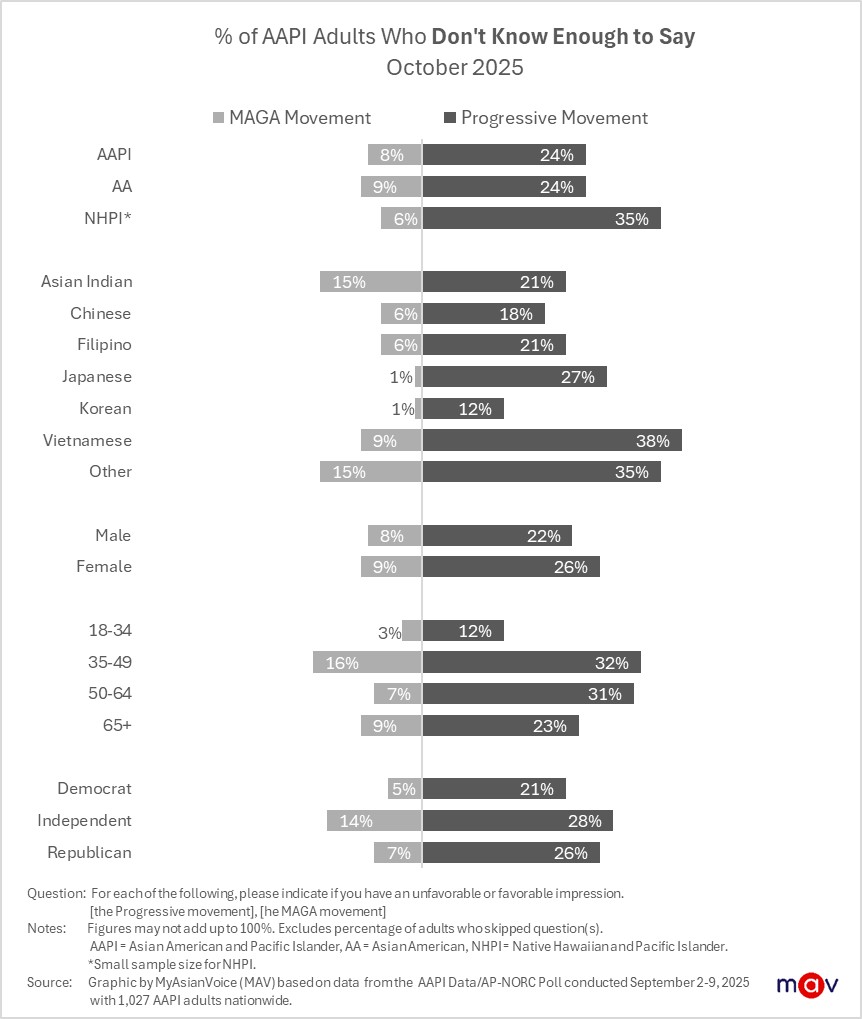
Similarly, 24% of AAPI adults say they don’t know enough to express an opinion about the Progressive movement. This sentiment is especially common among Vietnamese Americans at 38%, Native Hawaiian and Pacific Islanders at 35%, and AAPI adults aged 35–49 at 32%. (This finding for Native Hawaiian and Pacific Islanders should be interpreted with caution due to its small sample size.)
Ultimately, Asian Americans display varied and divided impressions of capitalism and socialism. While most continue to hold positive views of capitalism, a substantial share also view socialism positively, particularly among the younger generation. However, many also say they don’t know enough to form an opinion.
***
This article contains original analysis and content developed by MyAsianVoice based on primary data published by third parties. While the underlying data may be publicly available, all insights, visualizations, and derived content, unless otherwise noted, are the intellectual property of MyAsianVoice and are protected under international copyright and intellectual property laws. If you use, reference, or cite any part of our analyzed data or content, you must provide full proper attribution. Required citation include: MyAsianVoice’s full name, title of the article, and direct link to the article.
Helpful Resources
AAPI Data | AP-NORC Survey September-October 2025 (AAPIData)
Get a monthly dose of our latest insights!




About
myasianvoice

At MyAsianVoice, we make disaggregated U.S. Asian data visible and accessible.
Subscribe to receive our latest insights >>