Most people see graduate degrees, like master’s, doctorates, or professional degrees, as markers of success and pathways to higher-paying careers. And not surprisingly, the number of people earning these degrees has been rising across all racial groups in recent decades. Today, Asian adults in the U.S. are most likely to hold advanced degrees, a pattern shaped by decades of immigration policies that favored highly skilled workers, especially in technology and healthcare, as well as America’s increased enrollment of international students. That said, there are substantial disparities in rates of advanced degree attainment within Asian subgroups—Taiwanese and Indian adults have the highest rates, while Hmong and Laotian adults have much lower rates. However, recent federal policy changes under the second Trump administration affecting employment visas, student visas, and U.S. residency applications are making it more difficult for highly educated and highly skilled individuals to stay and work in the United States. These policies are likely to have a significant impact on the Asian community and could shape the future composition of the U.S. Asian population.

Most people see graduate degrees, like master’s, doctorates, or professional degrees, as markers of success and pathways to higher-paying careers. And not surprisingly, the number of people earning these degrees has been rising across all racial groups in recent decades, though at different rates. Today, Asian adults in the U.S. are most likely to hold advanced degrees, a pattern shaped by decades of immigration policies that favored highly skilled workers, especially in technology and healthcare, as well as America’s increased enrollment of international students.
By racial group
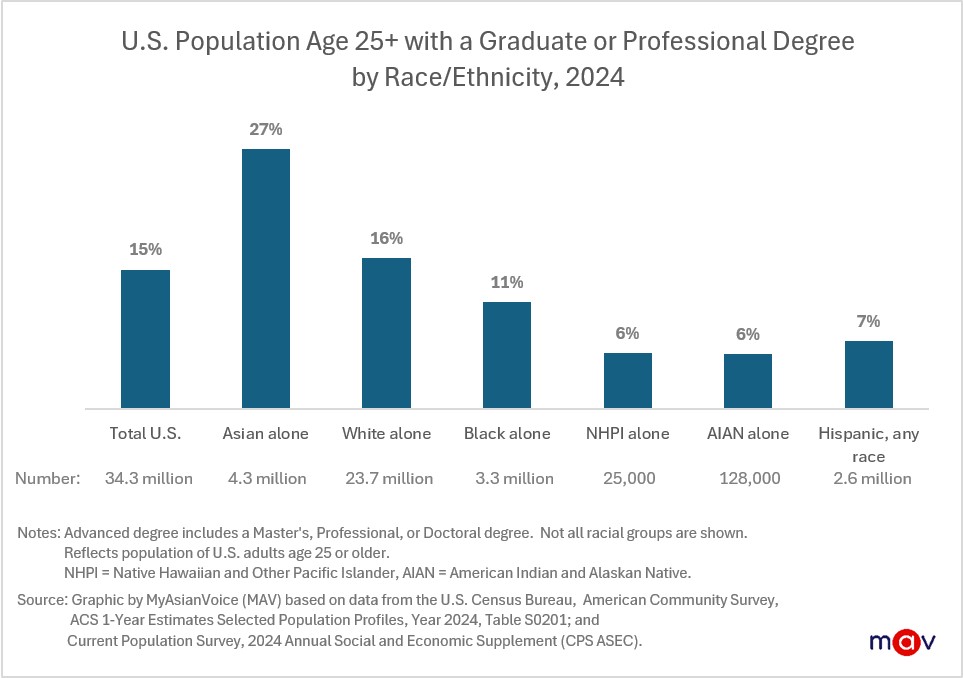
According to 2024 Census data, about 34 million of all U.S. adults age 25 or older, or 15% of this population, hold an advanced or post-bachelor’s degree, including master’s, doctoral, graduate, or professional degrees. Asian adults have the highest rate at 27%, followed by Whites at 16%, Blacks at 11%, Hispanics of any race at 7%, and Native Hawaiian and Pacific Islanders (NHPI) and American Indian and Alaska Natives (AIAN) each at 6%.
By gender
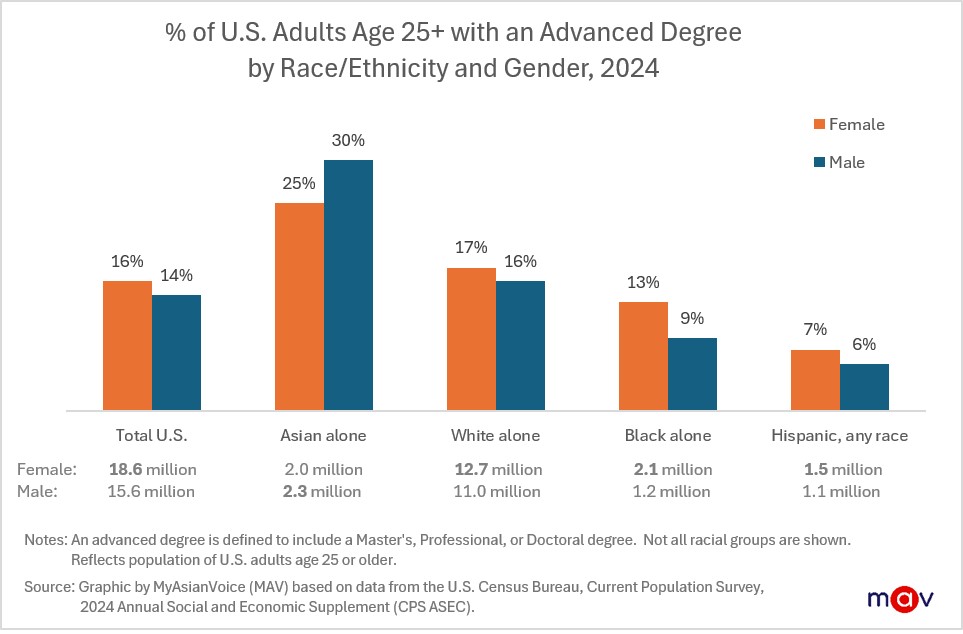
Overall, women in the U.S. are more likely than men to hold an advanced degree. However, this trend is reversed for Asians, where men are more likely than women to have an advanced degree. However, when looking at graduate enrollment excluding international students, Asian American women enroll in graduate programs at a higher rate than Asian American men, the same trend seen across all racial groups.
By Asian subgroup
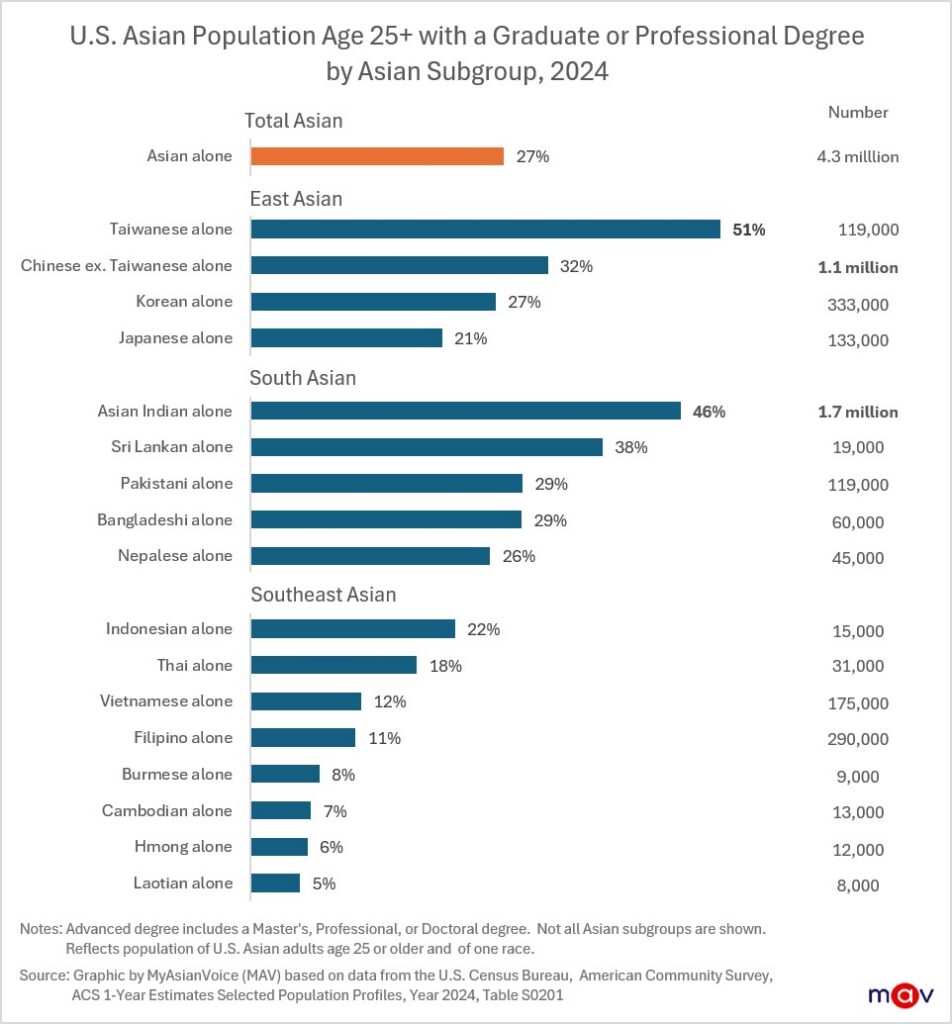
There are substantial disparities in advanced degree attainment within Asian subgroups. Groups that have often benefited from skilled immigration pathways and international student pipelines like Taiwanese, Indian, and Chinese hold the highest rates for advanced degrees at 51%, 46%, and 32%, respectively. In contrast, rates are much lower among Laotian (5%), Hmong (6%), Cambodian (7%), and Burmese (8%) adults, many of whom came to the U.S. as refugees.
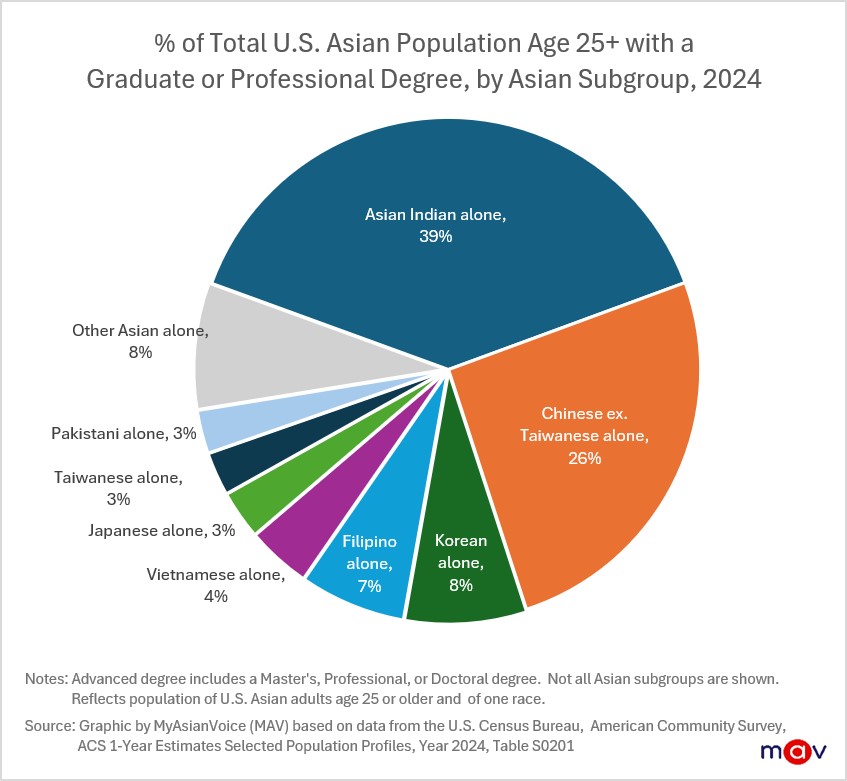
Indian, Chinese, and Korean adults together make up 72% of all Asian adults age 25 or older with an advanced degree. Indian adults account for the largest share at 39%, followed by Chinese (excluding Taiwanese) at 26%, and Korean at 8%. Notably, India, China, and South Korea are also the top 3 countries of origin for international students from Asia.
Driven by skilled and student migration
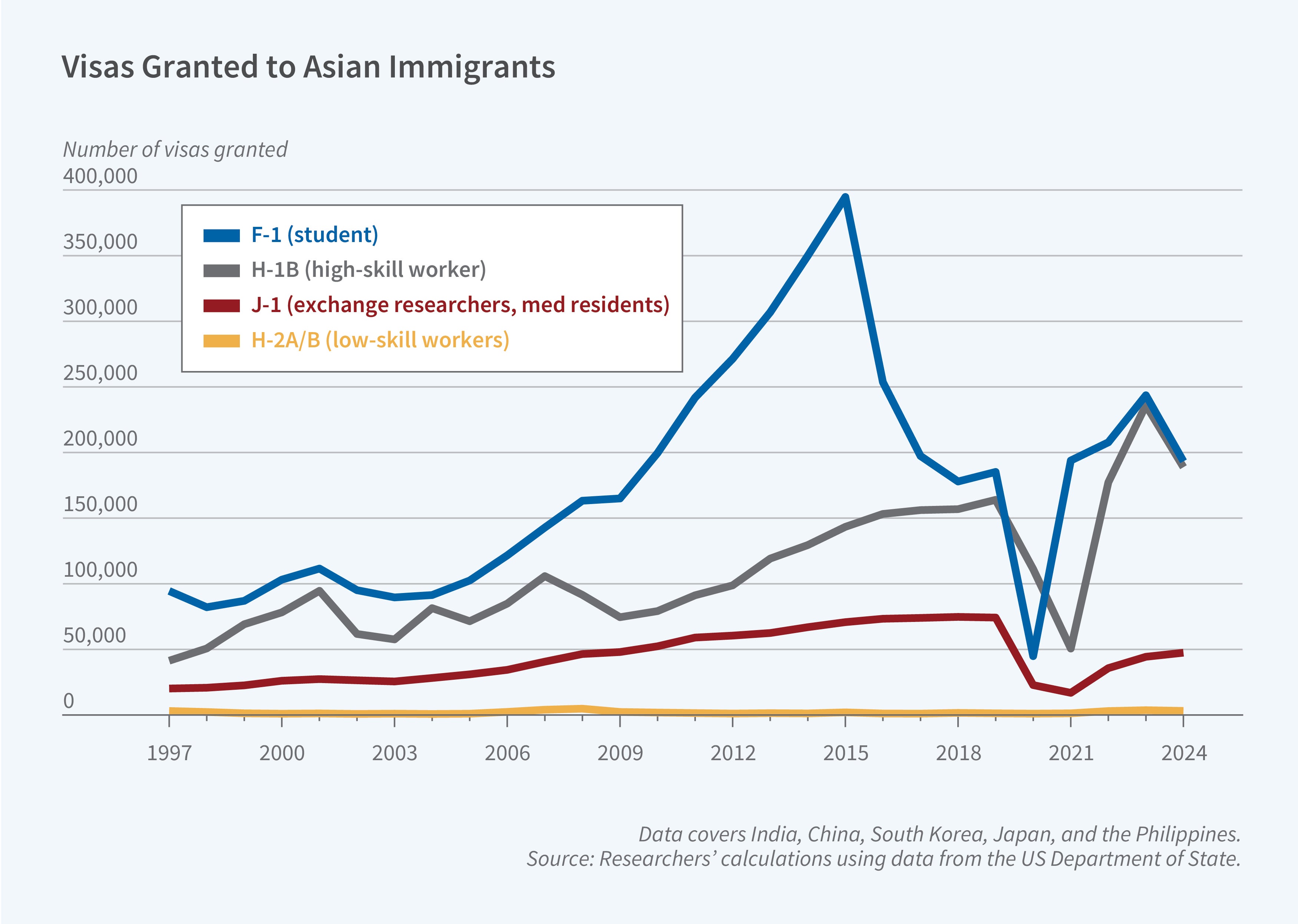
A National Bureau of Economic Research (NBER) working paper, From Asia, With Skills, highlights how rising U.S. demand for skilled labor alongside Asia’s education boom has fueled high-skill migration that reshaped innovation, universities, and healthcare in the United States. Between 1990 and 2019, individuals from India, China, South Korea, Japan, and the Philippines accounted for 38% of the growth in U.S. software developers, 25% of the increase in scientists and engineers, and 21% of the growth in physicians. Today, 25% of U.S. physicians are international medical graduates (IMGs), with India, Pakistan, and the Philippines among the most common countries of origin.
Immigration pathways have played a key role. The H-1B visa program, created in 1990 for specialty occupations, became a major route for highly educated and skilled workers. Student visas also emerged as an important alternative pathway. Both have contributed to high educational attainment, as many individuals entering through these channels already hold or go on to earn advanced degrees. There was a notable dip in 2020 due to the Covid-19 pandemic.
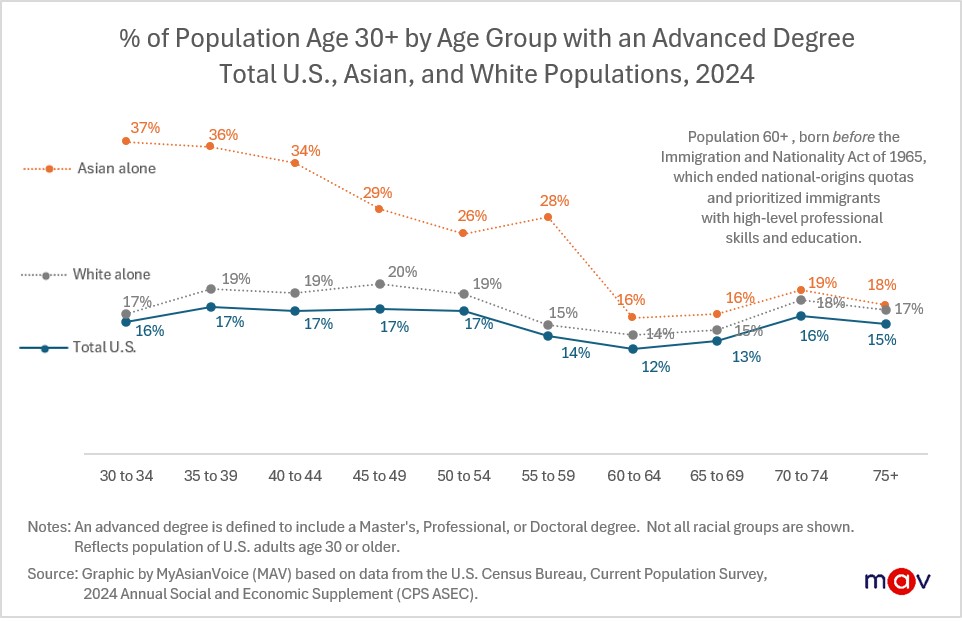
These patterns show up across age groups among the U.S. Asian population. Because skilled immigrants and international students tend to be younger, younger Asian adults are more likely to hold advanced degrees than older ones. For example, 37% of Asians age 30–34 have an advanced degree, compared with 16% of those age 60–64. For comparison, the share of all U.S. adults age 30 or older with an advanced degree has stalled at 17%, while the rate among White adults has plateaued at 20%.
International students from Asia and graduate study
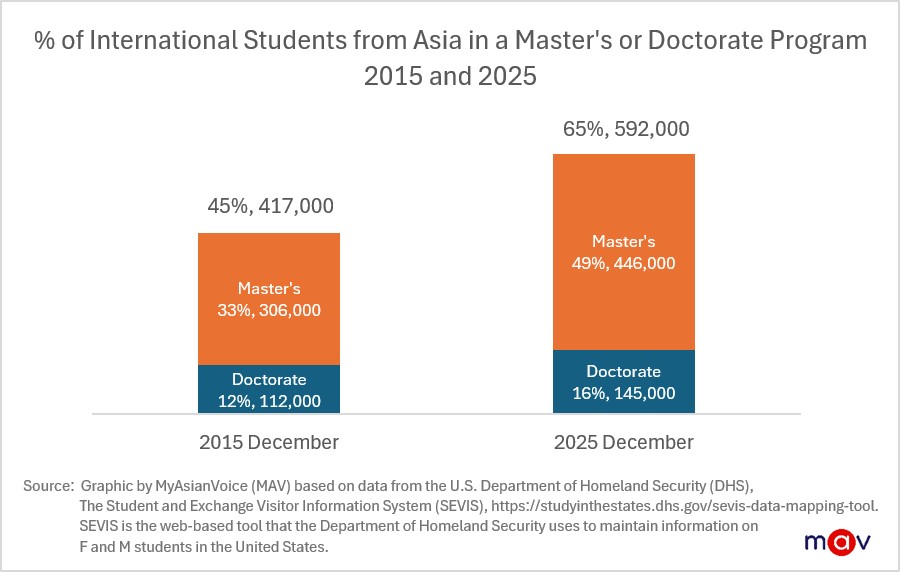
Data from the U.S. Department of Homeland Security (DHS) show that students from Asia make up more than 70% of all international students in the United States, and more than half are enrolled in master’s or doctoral programs, especially in STEM fields. As of December 2025, there were 908,000 international students from Asia, led by India (354,000), China (239,000), and South Korea (43,000). 65% or 592,000 of these students are enrolled in advanced degree programs. A decade earlier, only 45% were in advanced programs.
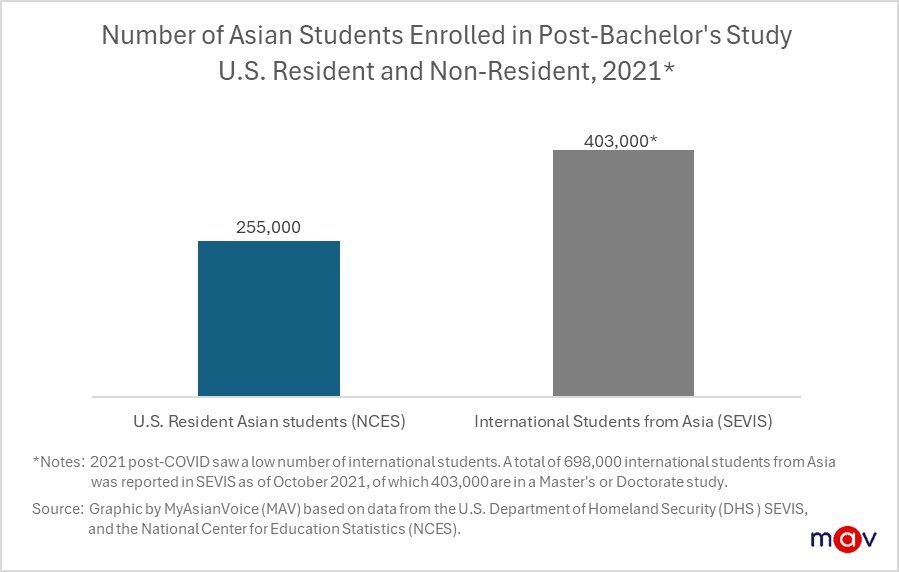
The scale becomes even clearer when compared to domestic enrollment. International students from Asia are more likely to pursue advanced degrees than domestic Asian students. For example, even in a low international student enrollment year in 2021 (the most recent year available) due to the Covid-19 pandemic, the National Center for Education Statistics (NCES) data show 403,000 international Asian students enrolled in post-baccalaureate programs, compared with 255,000 domestic Asian students.
Disparities in unemployment
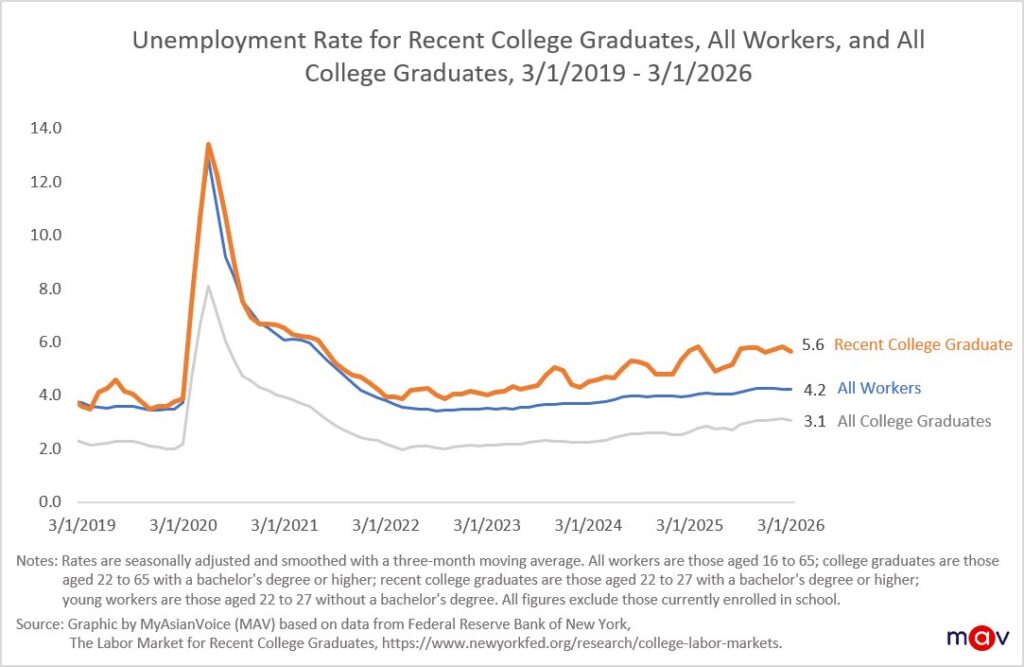
Decades of immigration policies favoring highly educated workers have led to about one third of the Asian workforce in the U.S. holding an advanced degree. At the same time, the economic payoff of an advanced degree varies widely by major, and recent graduates of all races are facing a challenging job market. As of March 2026, the unemployment rate for recent college graduates with a bachelor’s degree or higher was 5.6% compared to 4.2% for the overall workforce. Since 2019, recent graduates have consistently had higher unemployment rates than the general workforce.
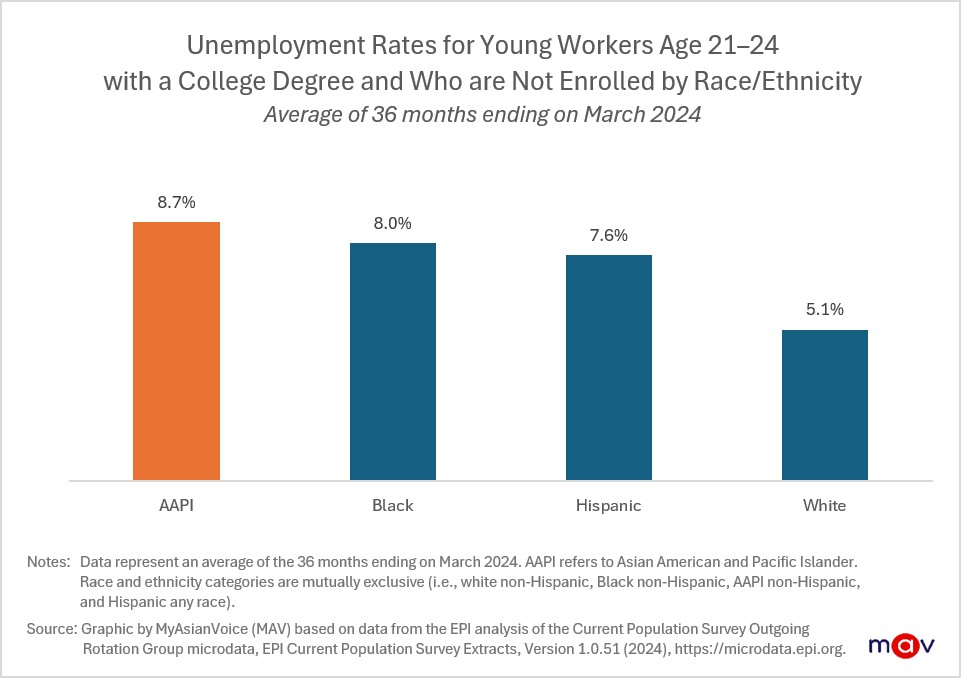
Disparities also persist across racial groups. Among recent college graduates age 21-24 who are not enrolled in further education and do not hold advanced degrees, Asian and other minority graduates face higher unemployment than their White peers. According to the Economic Policy Institute, the unemployment rate for White recent graduates was 5.1%, compared with 8.7% for Asian American and Pacific Islanders (AAPIs), 8.0% for Blacks, and 7.6% for Hispanics. These gaps point to ongoing inequalities in access to job opportunities.
An uncertain future
Recent federal policy changes under the second Trump administration affecting employment visas, student visas, and U.S. residency applications are making it more difficult for highly educated and highly skilled individuals to stay and work in the United States. These policies are likely to have a significant impact on the Asian community and could shape the future composition of the U.S. Asian population.
***
This article contains original analysis and content developed by MyAsianVoice based on primary data published by third parties. While the underlying data may be publicly available, all insights, visualizations, and derived content, unless otherwise noted, are the intellectual property of MyAsianVoice and are protected under international copyright and intellectual property laws. If you use, reference, or cite any part of our analyzed data or content, you must provide full proper attribution. Required citation include: MyAsianVoice’s full name, title of the article, and direct link to the article.
Helpful Resources
Educational Attainment in the United States: 2024 (U.S. Census)
Postbaccalaureate Enrollment (National Center for Education Statistics)
Race and Ethnicity in Higher Education: 2024 Status Report (American Council on Education)
SEVIS Data Mapping Tool (U.S. Department of Homeland Security)
Get a monthly dose of our latest insights!





About
myasianvoice

At MyAsianVoice, we make disaggregated U.S. Asian data visible and accessible.
Subscribe to receive our latest insights >>